When Hurricane Helene came through in late September 2024, it caused widespread tree damage across the Upstate. For a lot of households, the fallen trees were eventually cleared but the stumps stayed behind.
Storms will keep doing that. This guide covers the order of work after a storm, what’s safe to touch, how insurance tends to treat stumps and how to keep the cost of the stump part down.
Safety comes first
Treat every downed line as live. Stay well clear and call your power company. Don’t try to move limbs off a line, even with something that seems safe to hold.
Trees that are hung up in other trees, leaning on a roof or bent under tension are for professional tree crews. A trunk pinned under load can spring back with enough force to kill someone when it’s cut. The stump can wait.
The order of work
After a storm, stumps come last. The usual order is:
- Make it safe. Lines cleared by the utility, and hung or leaning trees dealt with by a tree service.
- Document the damage. Photos for your insurer before anything is moved, if it’s safe to take them.
- Remove the tree. Trunk, limbs and debris cut up and hauled or stacked.
- Grind the stumps. Once the area is clear and the ground has firmed up.
- Fill and reseed. Topsoil and seed or sod over the ground-out spots.
If you can, ask the tree crew to cut stumps reasonably low and to leave the area around them clear of rocks, cables and debris. That makes grinding quicker.
Uprooted root plates
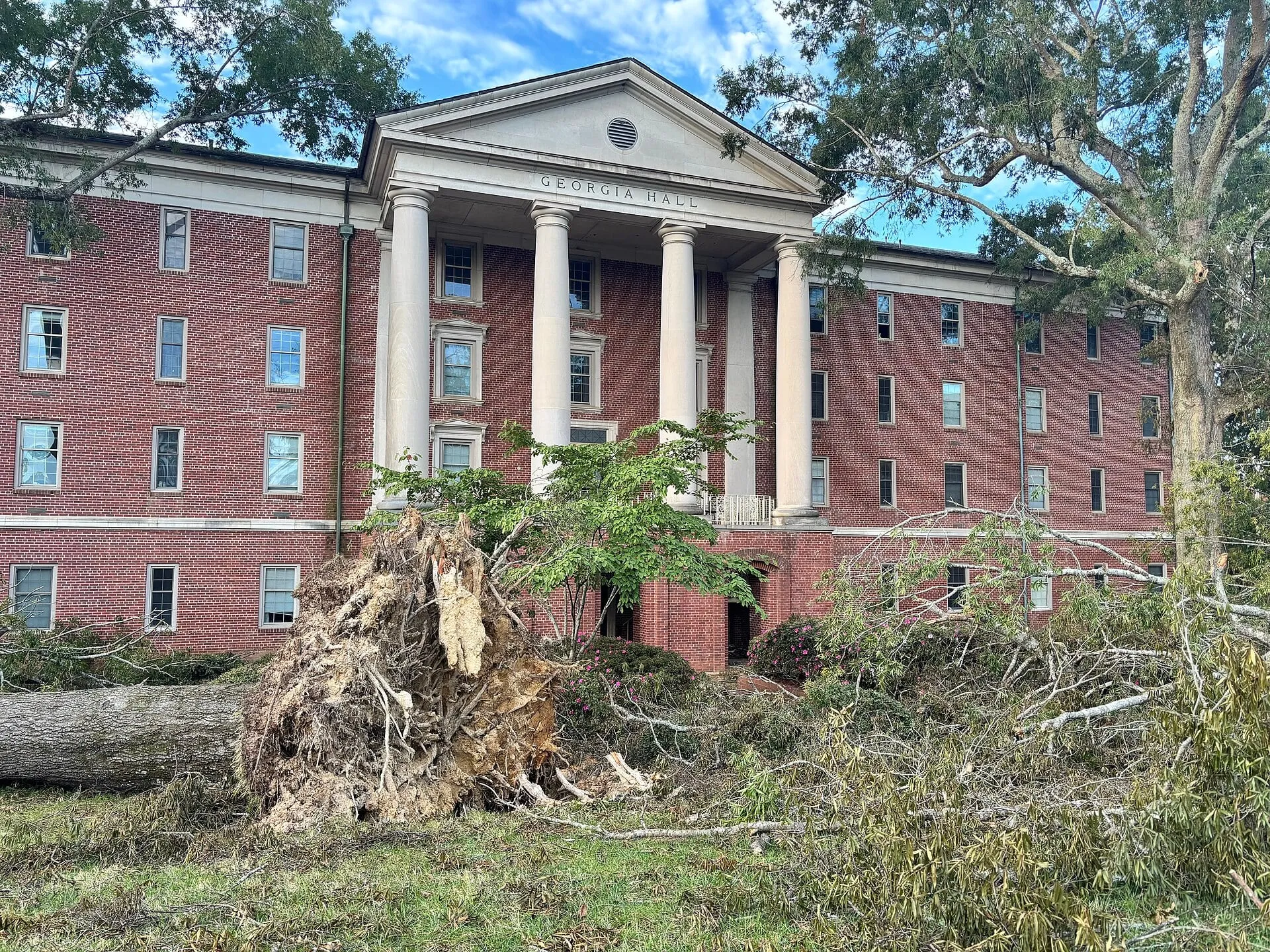
When a tree blows over rather than snapping, the roots come up as a flat plate of soil and wood, often taller than a person, with a crater beside it. In red clay that plate can weigh a great deal.
Once the trunk is cut off, the weight that was holding the plate up is gone, and it can tip back into the hole without warning. Keep children and pets away from it, and leave the trunk cut to the tree crew.
Most root plates either settle back on their own or are set back down during cleanup. After that, they can usually be ground. Expect one to be priced as a larger stump, because the root mass spreads much wider than a normal trunk.
Insurance and stump grinding
Every policy is different, so read yours. As a general pattern, homeowners policies often help with removing a tree that fell on an insured structure, like the house, a detached garage or a fence, up to a limit. Trees that fell without hitting anything are often not covered.
Stump grinding and removal are frequently excluded even when the tree removal is covered. Ask your adjuster directly before the stump work is done, and keep the stump work on its own invoice so it’s easy to submit or set aside.
Photos that help a claim
If it’s safe, photograph everything before it moves:
- Wide shots showing the tree and what it hit.
- Close-ups of damage to the roof, siding, fence or vehicles.
- The base of the tree and the root plate, if it uprooted.
- The same views after cleanup.
Keep every receipt. Your phone records when each photo was taken, which helps if questions come up later.
Batching stumps with neighbors
After a big storm, several houses on the same road often have stumps. Getting them done on one visit spreads the travel and setup, so each household is less likely to pay a full job minimum for a single stump.
If your neighbors are interested, list each address and whose stumps are whose when you ask for a quote. Our multi-stump and lot clearing page covers larger storm cleanups, and our guide to what stump grinding costs around Seneca explains why batching saves money.
Getting your storm stumps quoted
Measure each stump across the widest part at ground level, and photograph it along with a wider shot showing access. Our guide on how to measure a stump walks through it. Mark the stumps with paint or flags, and point out any private lines like irrigation or a power run to a shed, since 811 doesn’t mark those.
We request an SC811 locate before grinding, and we can work while you’re not home if the stumps are marked and the gates are open. When you’re ready, get a quote with your sizes and photos.